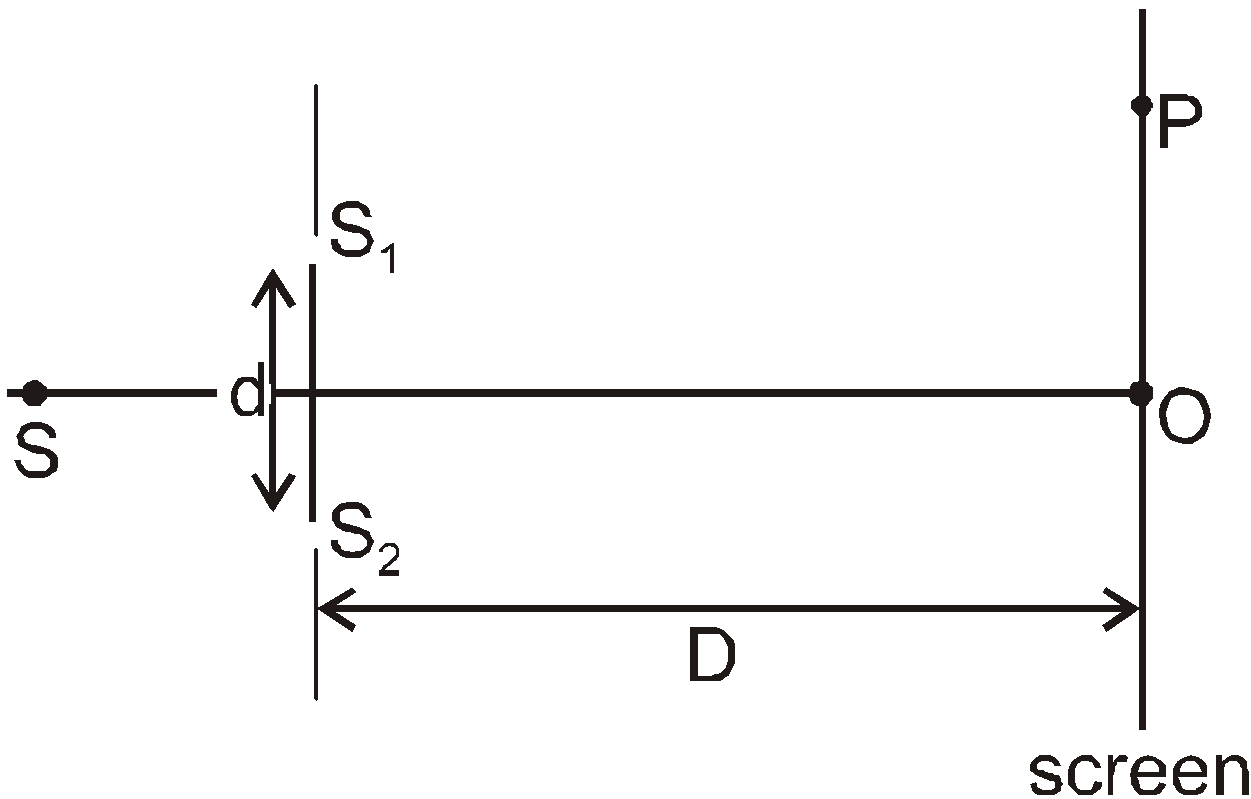
In a typical Young's double slit experiment, S 1 and S 2 are identical slits and equidistant from a point monochromatic source S of light having wavelength λ . The distance between slits is represented by d and that between slits and screen is represented by D. P is a fixed point on the screen at a distance
y =  from central order bright on the screen: where D o , d o are initial values of D and d respectively. In each statement of column- I some changes are made to above mentioned situation. The distance between the slits and the source is very large. The effect of corresponding changes is given in column- II . Match the statements in column- I with resulting changes in column- II .
Column- I column- II
 . (neglecting absorption in medium)
Text Solution
Verified by ExpertsA
r,s p,q,s p,q,s r,s
Sol. The y-coordinate of point P =  = half the fringe width. Hence initial intensity at P is zero.
As d is doubled, fringe width becomes half. As a result first order bright is formed at P and optical path difference between interfering waves at P will increase.
As D is doubled, fringe width doubles, hence intensity at P cannot be zero. Also optical path difference between interfering waves at P will decrease.
Decreasing width of slit will reduce energy from S 1 . But as D is doubled intensity at P is changed from zero to non zero value. Hence all options are same as in case B.
As set up is submerged in water of refractive index  , fringe width reduces, optical path difference will become
  rd its initial value. Hence dark cannot be again obtained at P. Therefore intensity will increase P.
Prepare Smarter with CGP Edu
Get practice questions, solutions, and test series in one place.
Write a Review
Share your experience with this question and solution.
Commentary
Send your comment, doubt, correction, or feedback to admin.
Similar Questions
Explore conceptually related problems